When you shake someone's hand, you learn a lot in under a second: how big their hand is, how firmly they grip, whether they are hesitant or confident. Robots that are meant to touch people, to greet them, help them stand up or hand them objects, mostly learn none of this. Their hands are either blind or report a handful of joint torques.
I wanted to know how much a robot could infer about a person from touch alone, without cameras or motion capture. So I built a soft tactile skin for a humanoid hand and asked a simple question: if you grasp this hand once, what can it tell about your hand?
Building a soft skin for a humanoid hand
The skin is a glove of 90 individually addressable pressure sensors: 14 on each of the three fingers, 10 on the thumb and 38 on the palm. Each sensor is a small resistive sandwich. On a thin PET substrate sit concentric copper electrodes; on top of them, a layer of carbon-black polyolefin (Velostat) whose resistance drops when it is compressed; above that, a carbon-black rubber layer and a 1 mm silicone sheet that spreads the load and makes the surface feel soft rather than like a circuit board.
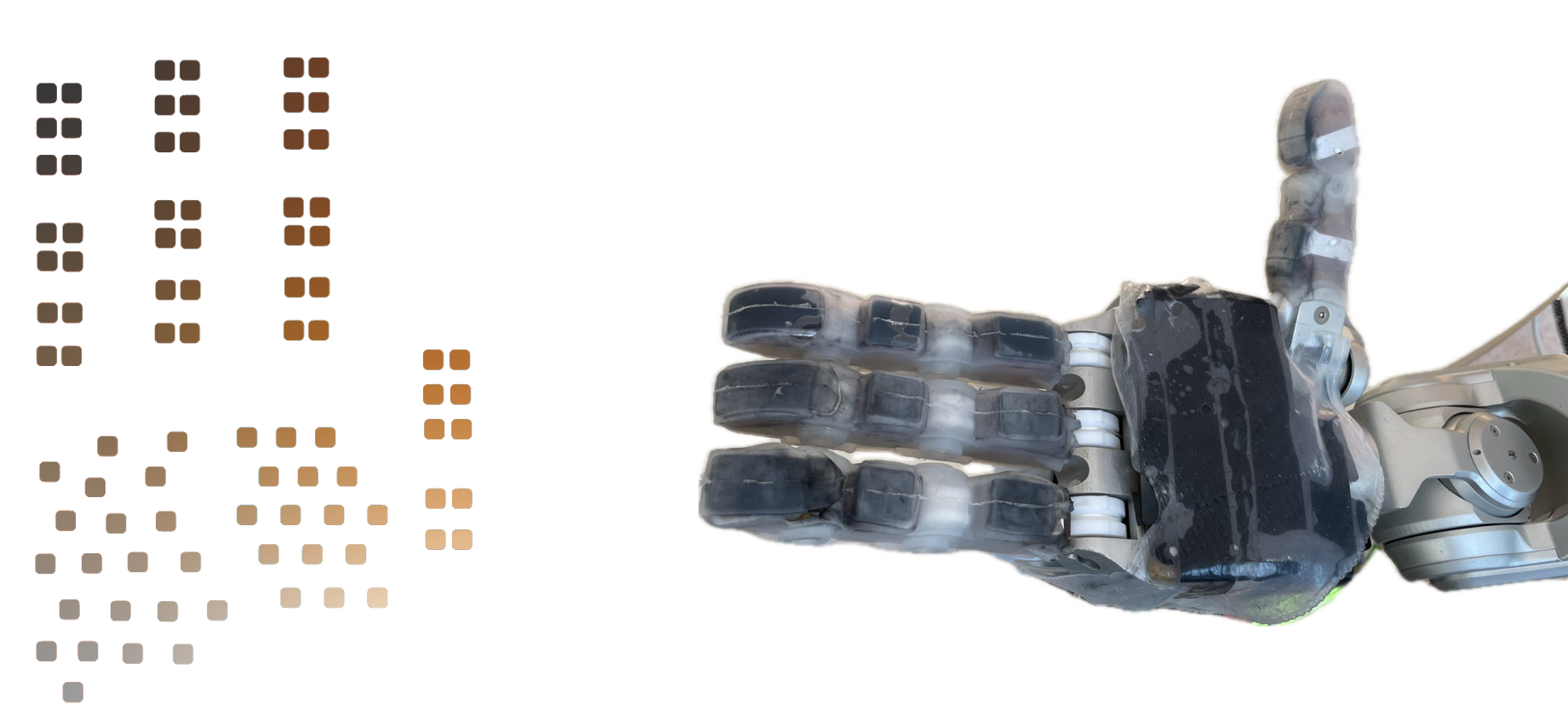 Left, distribution of the 90 sensors over the fingers, thumb and palm. Right, the assembled glove on the Meka hand.
Two design choices mattered from an engineering point of view. First, the substrates are flexible, so the array follows the curved geometry of the fingers instead of forcing flat patches onto them. Second, resistive sensing with off-the-shelf materials keeps the build accessible: no cleanroom, no nanomaterial printing. In the published version the 90 channels stream at 1.0 kHz.
Since then I have refined the sensor, with finite-element optimization of the electrode geometry, thinner layers, molded silicone and a new ROS 2 readout. That design is described in a paper that is currently under review, so I will only show the hardware here and leave its results for after acceptance.
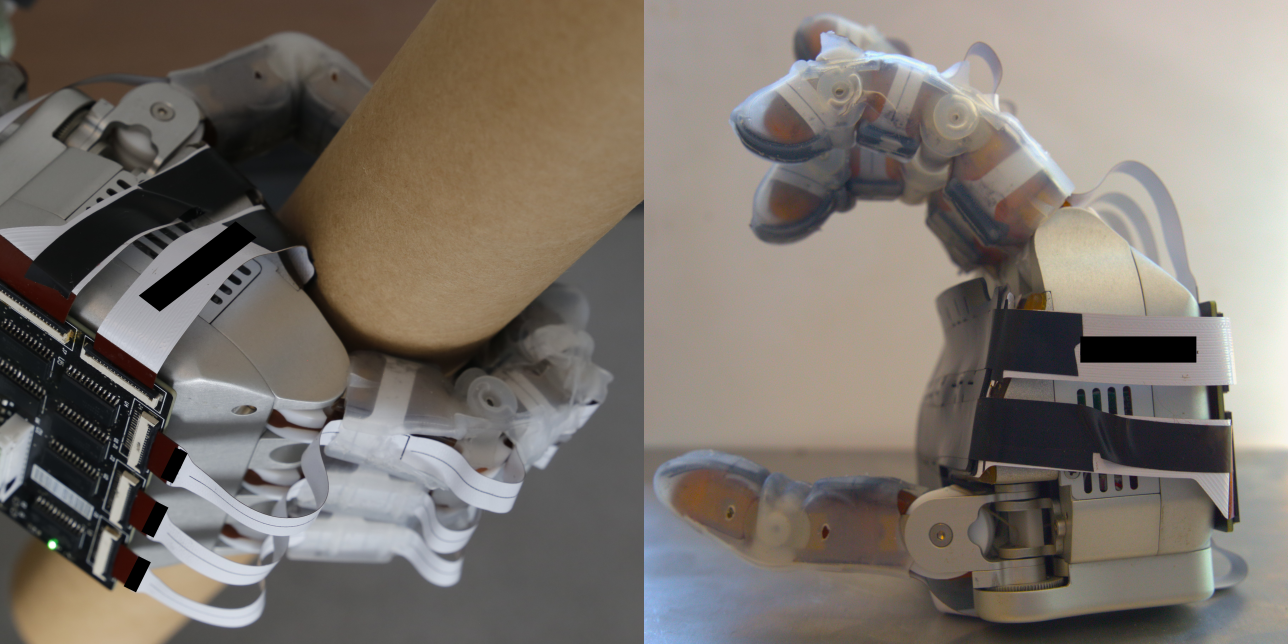 The current version of the glove on a robot hand, gripping a cylinder (left) and from the side (right), with the flex-PCB readout board. Hardware from the sensor paper under review.
Turning pressure into images
For the study published at ICSR 2025 [1], the glove was mounted on the hand of a Meka M3 humanoid. The hand stayed still; the person did the grasping. Nineteen participants, students and staff of Institut Polytechnique de Paris, each grasped the robot's hand three times: gently, neutrally and strongly, for about 3–5 seconds each. Before that, we measured each person's hand breadth, palm circumference and hand height.
The key step was to stop thinking of the data as 90 numbers and start treating it as a picture. Each sensor has a physical position on the hand, so every reading can be placed at that position in a 21×17 grayscale image. A grasp then looks like a pressure map: where the palm touched, which finger segments were loaded, how the contact spread. Images are what convolutional neural networks are good at.
For hand size, I summed the three hand measurements into one size score and split participants into thirds: Small, Medium and Large. Ten representative frames per participant gave 190 pressure images. A small CNN (three convolutional layers, then two fully connected layers) was trained on 60% of them and tested on the remaining 40%.
For grasp strength the question is about time as much as space, so I used a different tool. The 90-channel signal was cut into windows of 35 frames, sliding by 10 frames. For each sensor and window I computed five statistics (mean, standard deviation, range, median and variance), and a k-nearest-neighbors classifier labeled each window Gentle, Normal or Aggressive.
What worked, and what did not
Hand size was the clear success. The CNN reached 96% accuracy on the test set. Just as telling is how it got the remaining frames wrong: every error lands in the neighbouring class. It never mistook a small hand for a large one.
Breaking the matrix down per class shows where the difficulty sits: a few Large hands were read as Medium.
Grasp strength was harder: 68% accuracy over three classes. That is well above chance, but far from reliable, and most errors were between Gentle and Normal. In hindsight this is not surprising. The labels were subjective: one person's "normal" grip is another's "gentle", and the classifier saw window statistics rather than the shape of the grasp over time. Hand size is a fixed property of a person and shows up clearly in where the pressure is; grip intensity is a behavior and lives in how the pressure evolves.
Important
Passive tactile data alone was enough to classify a person's hand size with 96% accuracy. Grasp intensity, a subjective and temporal behavior, reached 68% and needs temporal models.
The people side mattered too. Participants highlighted the glove's softness and responsiveness, and 72.2% felt confident interacting with it. But 42.5% reported some discomfort, mostly because the Meka hand's size and shape did not fit their hands, and only 29% felt it resembled holding a human hand. A good skin does not compensate for a hand with the wrong proportions.
Why it matters
A robot that knows the size of the hand it is holding can calibrate its own grip: firm enough to feel engaged, gentle enough to be safe for a small or fragile hand. That is the basis of a personalized handshake, and the same logic applies to assistive robotics, where a robot helps someone stand, walk or take an object, and to safety in any physical contact, where pressure distribution is a more direct signal than joint torque.
There is also an industry angle. Inferring someone's hand from vision or motion tracking needs a clear view of a hand that, during contact, is wrapped around the robot's. A tactile skin measures the contact itself, with no line-of-sight requirement. And the hardware is built from accessible materials and processes, which matters if tactile hands are to leave the lab.
Limitations and next steps
Warning
Nineteen participants from one institution is a small, homogeneous sample. The size classes are thirds of this sample, not population norms, and the 96% comes from 76 test frames.
The natural next steps follow from what did not work: temporal models such as LSTMs or temporal CNNs for grasp dynamics, more and more diverse participants, and a more anatomically accurate robot hand. Beyond the hand, the same kind of skin could cover other body parts such as the forearm, chest or back, and other grippers.
The step that came after this study was to let the robot shake hands actively rather than be grasped. We studied what makes such a handshake feel right, in terms of compliance, grip and synchrony, in our ICRA 2026 paper [2]. The refined glove is aimed at exactly this kind of dynamic contact; more on it once its paper is through review; the full sensor reference is on the tactile array project page.
References
- Adnan Saood, Adriana Tapus. Human Hand Shape and Grasping Behavior Estimation using a Humanoid Hand with a Tactile Interface. 17th International Conference on Social Robotics (ICSR 2025), Springer, 2025.
- Adnan Saood, Adriana Tapus. Contributing Factors in Human-Robot Handshake: Compliance, Hand Grip, and Synchrony. 2026 IEEE International Conference on Robotics and Automation (ICRA 2026), 2026.