Sit next to someone who is frightened and you know it before they say a word. Their breathing is fast and shallow; if you hold their hand, you may even feel their pulse. These signals are involuntary, and we read them almost without noticing. We also tend to fall into step with them: people unconsciously synchronize with the breathing and heart rhythms of those around them, a phenomenon called entrainment.
Social robots almost never use this channel. They express emotion with faces, gaze, gestures and speech, all voluntary cues. During my PhD at ENSTA, Institut Polytechnique de Paris (U2IS), with Prof. Adriana Tapus, I asked a simple question: what happens if a robot also has a breath and a heartbeat that you can see and touch?
Why involuntary cues
The literature gives good reasons to try. Breathing rate is a reliable indicator of emotional state: machine-learning models recognize emotions from it with 75–98 % accuracy. Heart rate goes up with fear and anger and down with amusement, and heart rate variability (HRV) is higher for amusement than for fear or anger. Physiological cues also make a body feel alive, which is part of what makes an interaction feel natural rather than scripted.
There is a practical angle too. Diaphragmatic breathing is one of the best-known non-drug techniques against anxiety, but people need guidance to learn it: one study used 20 training sessions over eight weeks. A robot that can show a slow breath, not just describe it, could be a patient and consistent coach.
Building a soft lung and heart
The result is a soft pneumatic interface on the chest of a Meka M3 humanoid, a robot with compliant series elastic actuators, two 7-DoF arms and an expressive 8-DoF head [1].
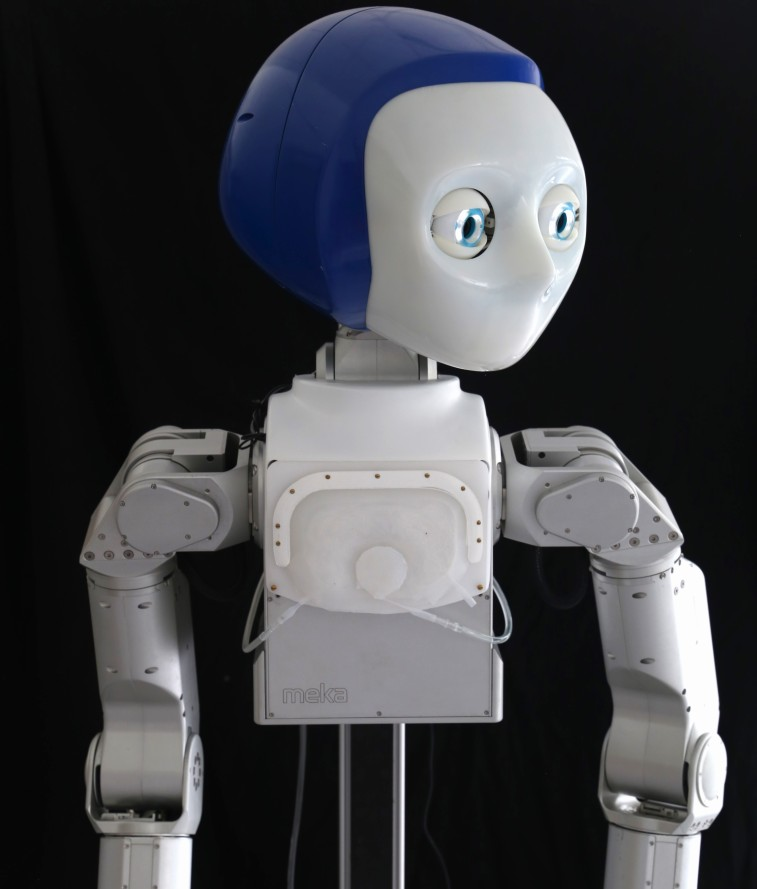 The soft haptic interface mounted on the chest of the Meka M3. The design creates a visual continuity between the lungs and the heart.
It has two silicone parts, cast in the same material and color so they read as one organ:
- a lung, a molded pouch of 0.015 to 0.035 L that inflates and deflates, driven by a silent 2 l/min pump up to 40 breaths per minute;
- a heart, a baromorphic disk of concentric rings whose center rises when the pressure inside increases, beating up to 135 BPM.
The whole interface is 170 × 120 × 3 mm. Valves and electronics live in a foam-lined, soundproof box at the base of the robot, connected to the chest by thin tubes. Noise mattered: a breathing robot that hisses or clicks is not calming.
The lung behaves like an electrical RC circuit. The pouch is a capacitor A, the pump a pressure source P_h, and two pneumatic resistors R_1 (inlet) and R_2 (outlet) set how fast it fills and empties. Inhaling charges the pouch as V = A P_h (1 - e^{-t/(R_1 A)}); exhaling discharges it as V = A P_h\, e^{-t/((R_1+R_2) A)}. This is what lets one valve produce very different breaths: switch slowly and the pouch fills completely (slow, deep breathing); switch fast and each inhale is cut short (fast, shallow breathing, as in fear). Try it:
Move the sliders to see one breath of the pneumatic lung. Inhale and exhale each last half a breath and the fill maps linearly onto the 0.015 to 0.035 L pouch range. At fast rates the pouch no longer fills: the shallow breathing used for fear.
Can people read a robot's emotions better?
In the first study, 12 students watched the robot express fear, sadness and happiness with arm gestures taken from the BEAT dataset, once with gestures alone and once with the lung and heart running at the same time. Breathing and heart rates followed values from the literature: 15, 20 and 30 breaths per minute and 50, 70 and 90 BPM for sadness, happiness and fear. Participants picked the emotion they saw, or "I don't know", for 30 short cues in random order.
 Participants during the study, in a calm, living-room-like environment.
Adding breathing and heartbeat to the robot's arm gestures raised overall accuracy from 0.33 to 0.49 (N = 12, within-participants).
Overall accuracy rose from 0.33 to 0.49, and the F1 score improved for every emotion. Sadness gained the most: its precision reached 0.60 and its F1 score went from 0.38 to 0.58. A slow breath and a slow heart seem to say "sad" more clearly than a drooping arm alone.
Can a robot help people breathe?
The second study moved from expression to care [2]. Eighteen participants first rested for 5 minutes, then did a stressful mental-arithmetic task: count down from 700 in steps of seven against a 150-second timer. The robot then guided a 5-minute diaphragmatic breathing exercise with its voice and its arms, torso and head. Ten participants saw and could feel the breathing chest; eight had the same robot without it. We measured state anxiety with the STAI-Y questionnaire before and after, and recorded heart rate, HRV, skin conductance and breathing with wearable sensors.
State anxiety fell in both groups (pooled decrease t = 2.361, p = 0.03). The difference between groups was not significant, and the spread is larger than either mean. N = 18.
The exercise worked: state anxiety dropped significantly across all participants (p = 0.03), and HRV rose, a sign of a more relaxed state.
HRV rose and heart rate fell slightly, from 80.23 ± 10.51 to 78.68 ± 8.52 BPM (both groups pooled). Neither differed significantly between the haptic and no-haptic groups.
But the honest headline is that the haptic chest did not make a statistically significant difference on any objective measure. The mean anxiety reduction was 2.38 points with it and 2.10 without, with standard deviations of 3.78 and 4.36. Skin conductance came closest (p = 0.0534) and remains inconclusive.
What surprised us
Three things stood out. First, people really did breathe with the robot. In the example below, the participant's breathing locked onto the robot's after the second breath, about 24 seconds into the exercise.
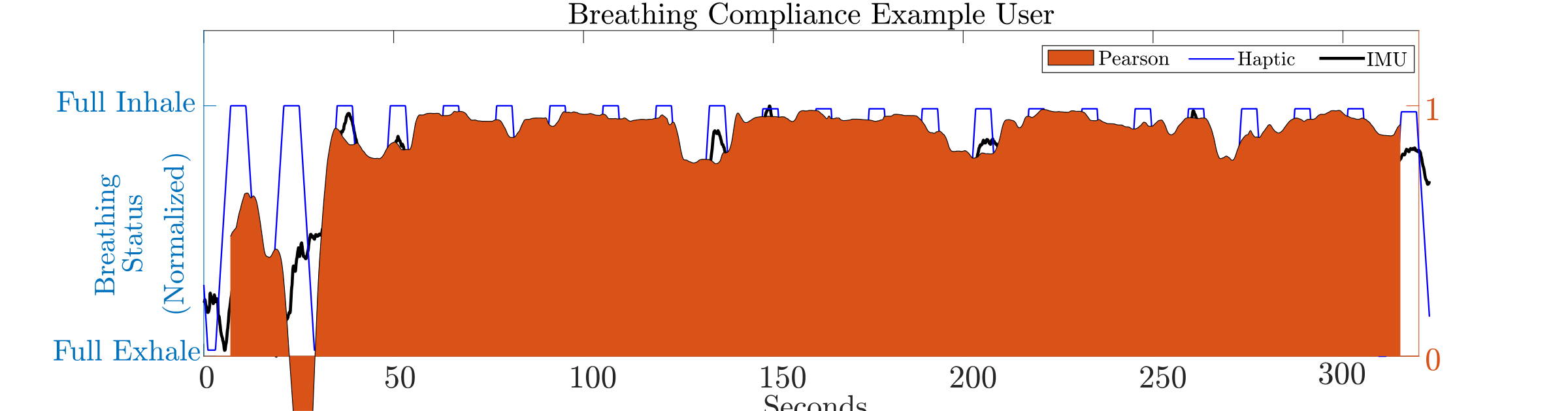 Example participant following the robot's breathing. Consistent matching appears after the second breath, about 24 s after the start.
Second, some participants closed their eyes and followed the hum of the robot's geared motors instead. We had worked hard to make the pneumatics silent; the robot's own body became an unplanned auditory cue.
Third, personality shaped emotion reading. With the haptic cues on, participants scoring higher on neuroticism or openness recognized emotions less well, which suggests that one cue design will not suit everyone.
The subjective side also differed from the numbers: in interviews, people who had the breathing chest described the robot as more natural and supportive, even though their anxiety scores did not drop significantly more.
What it means for social and healthcare robots
For robot designers, the message is that involuntary cues are a cheap, quiet extra channel. A thin silicone chest piece, a small pump and a few valves raised emotion-recognition accuracy from 0.33 to 0.49 on top of gestures, without changing the robot's mechanics. That matters for any robot meant to share space with people: companions, receptionists, care assistants.
For healthcare, the picture is more nuanced. A humanoid robot was a credible breathing coach: people followed it, and their anxiety and physiology moved in the right direction. Whether the haptic chest itself adds therapeutic value is still open. Our data do not show it; they also cannot rule it out with 18 participants.
Limitations and what comes next
Warning
Both studies are small (12 and 18 university students) and took place in a calm, controlled room. Accuracy with haptic cues is still below 50 %, although well above the 25 % chance level. Breathing and heartbeat were never tested separately, and the breathing study had no sham or no-robot control, so time effects and the robot's social presence cannot be fully separated from the haptic cue.
The next steps follow directly: larger, adequately powered studies; testing breath and heartbeat one at a time; a pressure-and-vacuum design with several valves to control inhale time, exhale time, depth and breath holding; and moving out of the lab into less controlled settings and onto simpler robots. The full system description, specifications and results are on the project page.
References
- Adnan Saood, Yang Liu, Heng Zhang, Adriana Tapus. Designing a Haptic Interface for Enhanced Non-Verbal Human-Robot Interaction: Integrating Heart and Lung Emotional Feedback. 2024 IEEE-RAS 23rd International Conference on Humanoid Robots (Humanoids), 2024.
- Adnan Saood, Yang Liu, Adriana Tapus. Diaphragmatic Breathing Guidance Using a Humanoid Robot with a Soft Robotic Haptic Interface for Anxiety Reduction. 16th International Conference on Social Robotics (ICSR 2024), Springer LNCS, 2025.