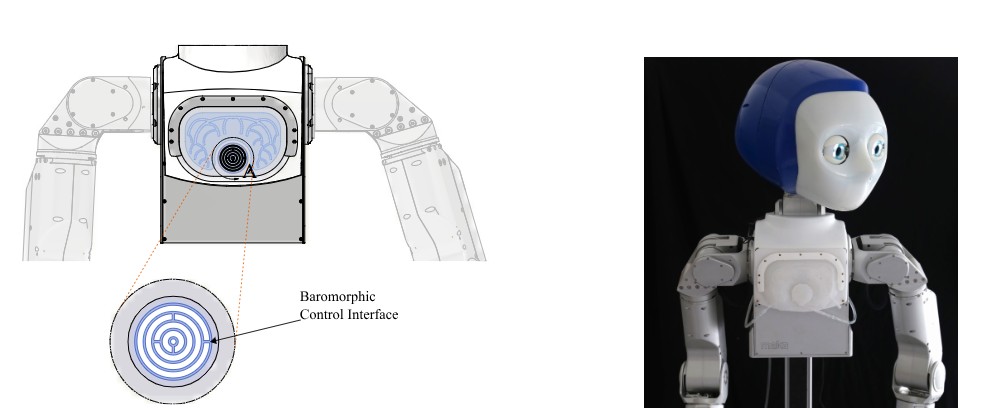
Project Overview
This research addresses a key challenge in socio-affective robotics: using haptic feedback not just to communicate information, but to regulate human emotional state. We developed a soft, wearable haptic interface that delivers synchronized heartbeat and breathing-pattern stimulation during interactions with a robot, with the goal of reducing anxiety and promoting relaxation.
Motivation
Human-robot interaction can provoke anxiety in users unfamiliar with robots. Conversely, gentle tactile stimulation (warm touch, slow rhythmic patterns) is known from psychology to reduce stress. By embedding such patterns into robotic interfaces, we can create a more emotionally supportive interaction.
Technical Approach
Haptic Hardware
A soft sleeve or wearable pad containing:
- Pneumatic actuators: Flexible, safety-critical design for gentle contact
- Pressure sensors: Real-time feedback to modulate stimulation intensity
- Pattern synthesis: Programmable heartbeat and breathing rhythms from cardiology/neuroscience literature
Interaction Scenarios
Tested in three contexts:
- First meeting with a humanoid robot (anxiety baseline high)
- During collaborative manipulation (task + social stress)
- Comfort and reassurance (robot as a therapeutic tool)
Evaluation
Participants rated stress/anxiety (subjective scale, cortisol assay, heart-rate variability) before, during, and after interactions with and without haptic feedback.
Key Findings
Preliminary results (published at Humanoids 2024, ICSR 2024/2025) show:
- Synchronized haptic feedback significantly reduces self-reported anxiety (p < 0.05)
- Heart-rate variability shifts toward parasympathetic dominance (relaxation state)
- Effects are strongest when haptic patterns are synchronized with robot motion and speech
Applications
- Therapeutic robots: Companion robots for anxiety disorders, PTSD, or burnout
- Hospital/care environments: Reducing patient stress during robot-assisted procedures
- Aging in place: Emotionally supportive assistive robots for elderly isolation
- Autism spectrum support: Calming haptic cues during sensory overload
- Industrial/workplace: Stress reduction during human-robot collaboration
Publications
- Humanoids 2024: Soft haptic interface design and feasibility study
- ICSR 2024: Preliminary user studies on anxiety reduction
- ICSR 2025: Extended protocol and mechanism analysis
Related Projects
- Tactile Array for Humanoid Hand (sensing counterpart to this work)
- Meka Robotic Hand Platform (hardware integration point)