A Handshake as a Research Question
One of the most fundamental—yet understudied—interactions between humans and robots is the handshake. Beyond its role as a social greeting, a handshake encodes rich tactile information about trust, intention, comfort, and personality. But what makes a robot's handshake feel natural? And can we quantify it?
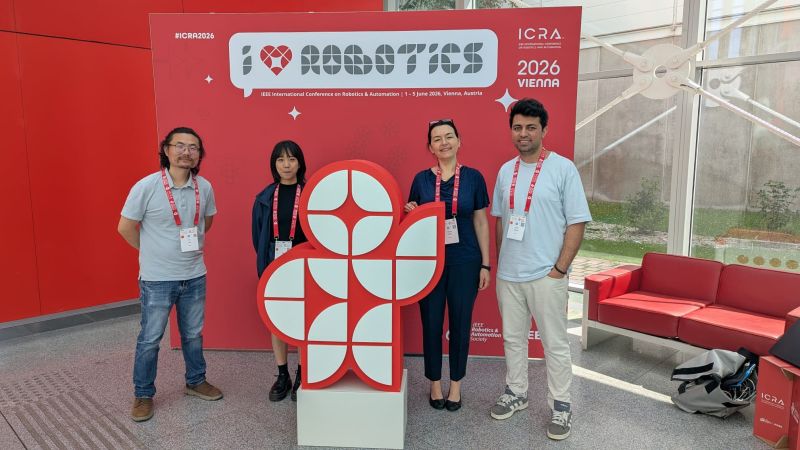
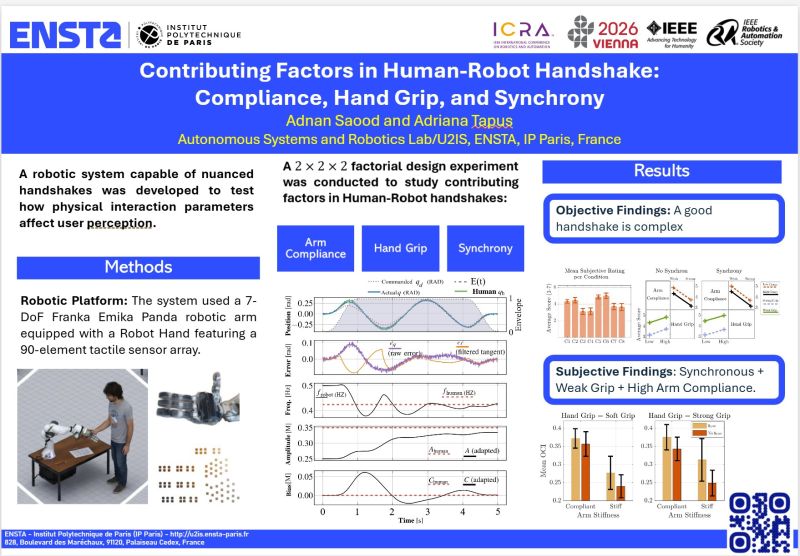
This summer at ICRA 2026 in Vienna, my co-author Prof. Adriana Tapus and I presented our paper, "Contributing Factors in Human-Robot Handshake: Compliance, Hand Grip, and Synchrony," which answers these questions through controlled experiment and statistical analysis.
The Experiment
We recruited 16 participants and had them perform handshakes with a Franka Emika Panda collaborative robot arm equipped with a custom adaptive gripper (based on the Meka hand) that allowed us to modulate:
- Compliance (softness/stiffness): Stiff, moderate, soft
- Grip force: Gentle, normal, firm
- Temporal synchrony: Robot tracking human motion perfectly, or with slight delays/early initiations
This gave us a 2×2×2 factorial design—16 total conditions. After each handshake, participants rated comfort, naturalness, and trustworthiness on validated scales. We also recorded motion data and force curves for post-hoc analysis.
Key Findings
(Results now in press; full paper available on request)
1. Compliance Matters Most
Soft, compliant contact is universally preferred. Rigid, stiff grasps are perceived as aggressive or defensive. A key design principle: adapt your grip impedance to feel human-like, not mechanical.
2. Grip Force Must Be Context-Aware
Moderate, socially-appropriate force outperforms both extremes:
- Too tight = uncomfortable, aggressive, unpersonal
- Too loose = impersonal, dismissive, low-effort
The sweet spot: force modulation that tracks human intent and personality.
3. Synchrony is Critical
Robots that anticipate human hand motion create more fluid, natural interactions than those who react passively. When the robot grasps slightly before the human hand is fully extended—or releases slightly before the human's grip loosens—the interaction feels coordinated and intentional.
Why This Matters
For Social Robotics
These findings inform design guidelines for collaborative robots and service robots. A robot that shakes hands with care and attention will be perceived as more trustworthy and less threatening.
For Humanoid Platforms
Upper-body control systems (Meka hands, industrial arms) can now tune their compliance, force profiles, and motion prediction algorithms based on these empirical results.
For Building Trust in HRI
Tactile interaction is a powerful channel for building rapport. A good handshake is a conversation starter.
For Assistive Robotics
Elderly or disabled users especially benefit from robots that can respond to physical touch with sensitivity and respect.
The Broader Context
This work sits at the intersection of tactile sensing, robot control, and human factors. It builds on my broader research into touch for robotics:
- Tactile Array for Humanoid Hand — enabling robots to sense hand contact
- Generative Tactile Affordance — enabling robots to predict tactile futures
- Soft Robotic Haptic Interface — enabling robots to express emotion through touch
A handshake, then, is a microcosm: it combines sensing (the robot feels the human's grasp), prediction (the robot anticipates release), and expression (the robot conveys care through compliance and timing).
Thank You to Vienna & the HRI Community
ICRA 2026 was an incredible gathering. The energy, the scale, the quality of research—it reaffirmed why we do this work. Special thanks to:
- Prof. Adriana Tapus for unwavering mentorship
- The Franka Emika team for robust collaborative hardware
- Our 16 brave participants who shook hands with a robot 16 times each
- The HRI community for pushing the frontier on what makes interaction feel right
Get Involved
If you're curious about the full methodology, statistical analysis, or want to replicate the study, the paper will be available on arXiv and IEEE Xplore. We're also releasing the motion capture dataset to enable future research.
Related:
- See the Human-Robot Handshake project for full technical details
- Publications: Saood & Tapus (2026), ICRA, Paper ThI1I.171
- See also: Tactile Array for Humanoid Hand and Soft Robotic Haptic Interface