Overview
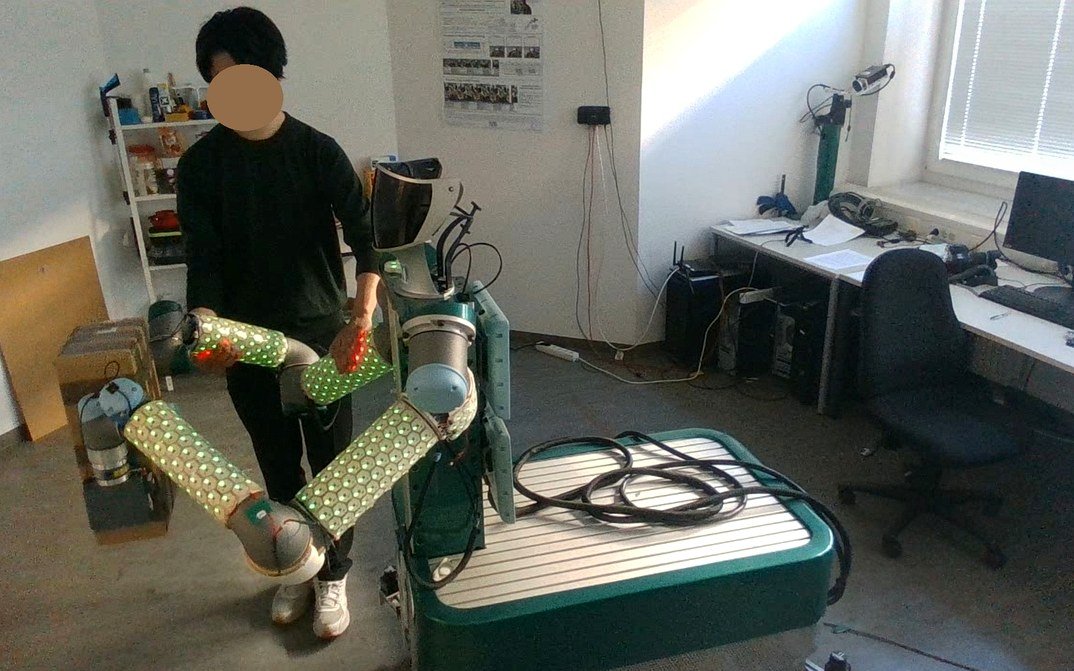
Can a robot covered in artificial skin be controlled by touching it, and is that better than a joystick? I studied this question during an Erasmus+ month at the Institute for Cognitive Systems (ICS), Technical University of Munich, in Prof. Gordon Cheng's team. We built a whole-body gesture interface on TOMM, ICS's dual-arm mobile manipulator, and compared it with a joystick in a within-subject study with 12 first-time users [1].
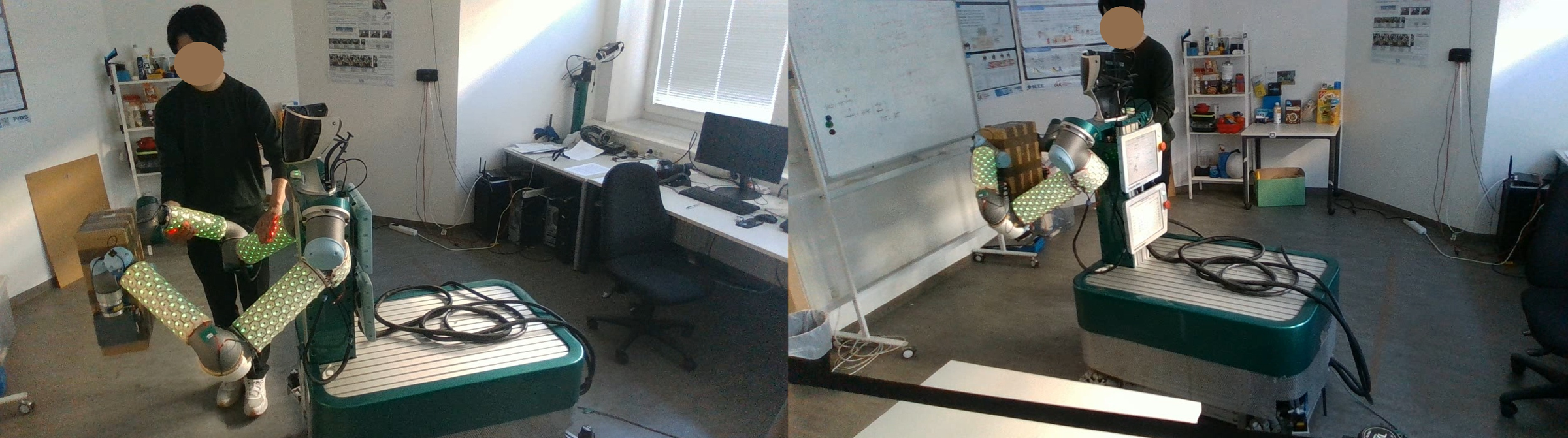 A participant moves TOMM from Table 1 to Table 2 while it holds the box; rotating the base is a persistent touch on two separate skin areas.
System
| Component | Specification |
|---|---|
| Robot | TOMM: two UR5 arms on a holonomic omnidirectional base, about 15 DoF in total |
| Robot skin | Large-area modular artificial skin on the arms; each cell senses proximity p and force f |
| Contact intensity | I = 0.7p + 0.3f, normalized to [0,1] by the firmware; contacts clustered into centroids and wrenches |
| Rates | Skin at 100 Hz, control stack at 200 Hz |
| Controller | Admittance M\ddot{\mathbf{x}} + D\dot{\mathbf{x}} + K\mathbf{x} = \mathbf{F}_{tactile} with M = I_{6\times6}, D = 2I_{6\times6}, K = 0 |
| Bimanual coupling | A virtual box frame between the end-effectors; both hands follow it through fixed transforms and keep facing each other |
Gesture vocabulary
Discrete events toggle controller states; sustained contacts become continuous wrenches that drive the admittance dynamics.
| Gesture | Where | Effect |
|---|---|---|
| Double-tap | Shoulder | Toggle between base mode and manipulation mode |
| Double-tap | Forearm | Grasp / release |
| Sustained single contact | Any skin patch | Translation only (base: F_x, F_y with \tau_z = 0; manipulation: box frame in X, Y, Z) |
| Sustained two contacts | Two separate patches | Base yaw only (F_x = F_y = 0) |
Magnitude gating, persistence requirements, refractory periods and spatio-temporal double-tap windows reject accidental touches.
Joystick baseline
The joystick drove the same admittance controller and the same discrete logic, so only the interface changed. One difference matters: the joystick axes allow simultaneous translation and yaw of the base, whereas the tactile interface keeps them in mutually exclusive gestures.
Method
- Participants: N = 12 (6 female, 6 male), age 28.6 ± 8.4 years, predominantly STEM backgrounds; 8 had prior robot experience.
- Design: within-subject, counterbalanced order (joystick vs tactile), no separate training phase, verbal instructions before each session.
- Task: drive to Table 1, grasp a box with both hands, carry it to Table 2 (about 180° of base reorientation) and release it.
- Phases annotated from video: going to Table 1, picking up the box, going to Table 2, putting down the box, plus "Other" (recovery or idle).
- Measures: phase durations and interaction errors; participant path length from two RealSense D435i cameras with MediaPipe pose and multi-view 3D fusion; system logs; NASA-TLX; 7-point questionnaires on control, predictability, comfort, trust and enjoyment; a post-experiment command-recall check.
Results
On first exposure the joystick was faster and less demanding. The tactile penalty concentrated in the pickup and transport phases.
Participants walked a median of 44.6 m with touch against 15.5 m with the joystick (p_Holm = 0.007), moving around the robot to reach the right patch.
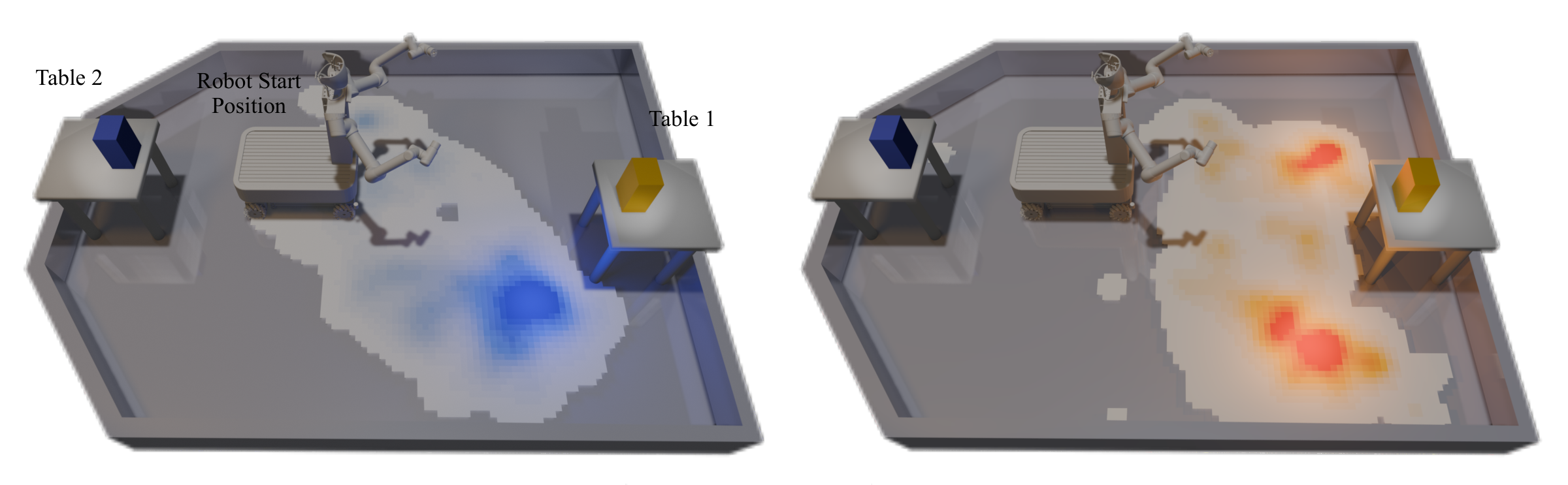 Cumulative human position during the task: centralized with the joystick (left), widely distributed with tactile guidance (right).
The effect sizes separate the large differences from the null ones: control, frustration, mental demand and the timing measures move strongly, while enjoyment and side switches barely change.
One result favors touch: commands anchored on the robot's body were remembered better.
Note
A small expert benchmark (two experts, three trials per interface) gave medians of 52.37 s with the joystick and 61.00 s with touch. The gap is much smaller than for novices, which suggests that much of the penalty comes from procedural friction and state management rather than from touch itself.
Discussion
Design implications
- Make the robot's state transparent: persistent visual or audio cues for the active mode.
- Treat patch placement as a design variable: larger or duplicated key patches, and tolerant zones that map a near-miss to the intended command.
- Integrate interaction primitives: separate continuous guidance from discrete commands more clearly, and support combined motions such as translation with rotation.
Warning
This is a pilot study: 12 technically experienced participants, no training phase (which favors the familiar joystick), a single task geometry, and an expert benchmark of only two people. The results are trends for first-exposure use, not a verdict on tactile interfaces.
Publications
PaperTactile Guidance for Complex Mobile Manipulation: Performance and Design ImplicationsUnder review · 2026Related
- Blog post: Steering a Robot by Touch: What 12 First-Time Users Taught Us About Tactile Guidance
- Tactile array for a humanoid hand
- Dual-channel tactile end-effector with a compliant finger
References
- Adnan Saood, Gordon Cheng. Tactile Guidance for Complex Mobile Manipulation: Performance and Design Implications. Under review, 2026.