Overview
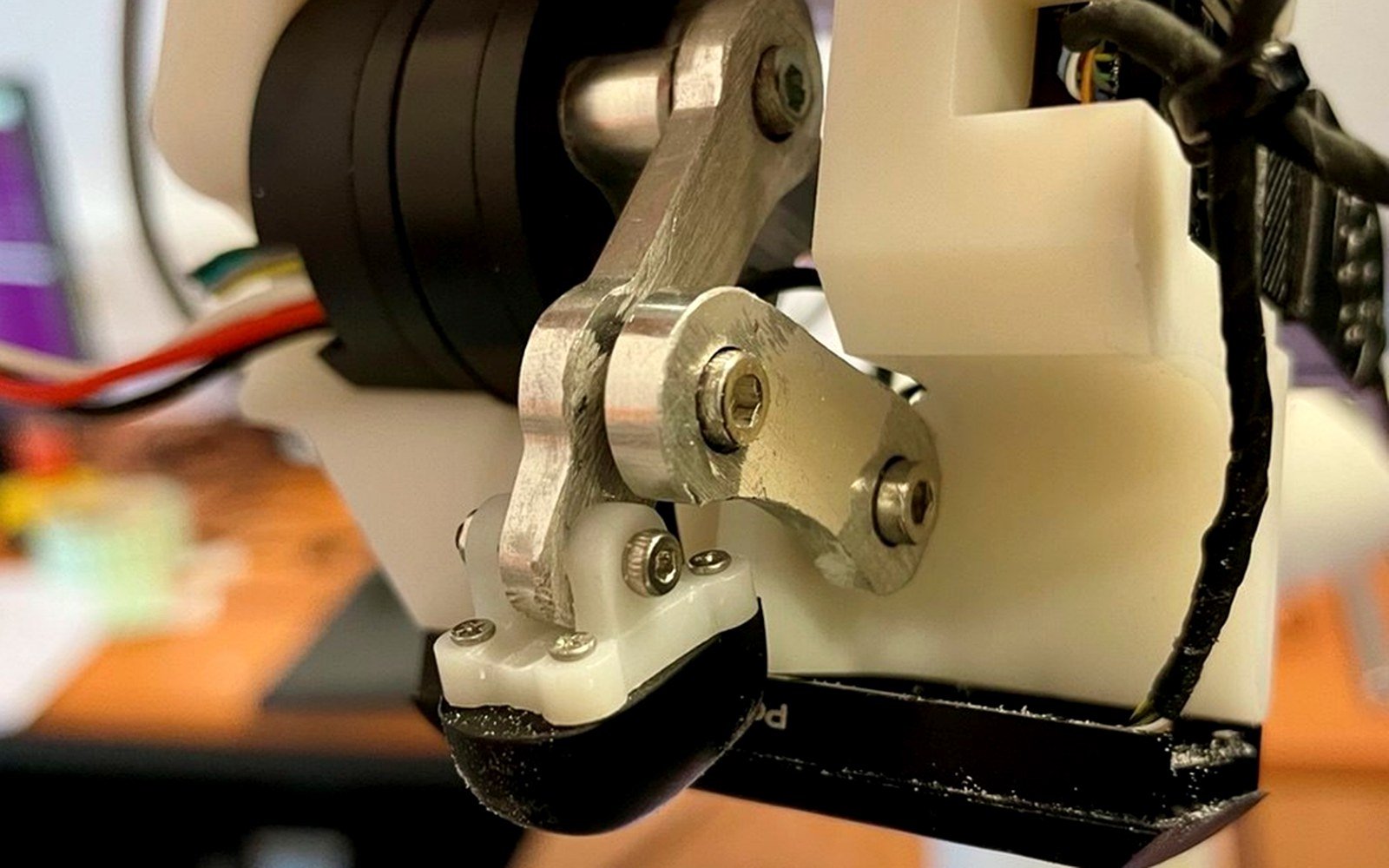
This is the tactile end-effector I designed and built for FRACTAL, my model of action-conditioned tactile affordance. It mounts on the wrist flange of a 7-DoF Franka Emika Panda and carries two independent tactile channels that observe the same contact event:
- a dense tactile array (PaXini GEN3 Omega L5321) that acts as the main sensing surface, and
- a compliant finger: a motor-driven four-bar linkage carrying a PaXini GEN3 S1813 Elite fingertip sensor, used for point contact and small features.
A ROS 2 control stack runs on top of it, with MoveIt 2 for free-space planning and a custom joint-space impedance controller that executes press, slide and tap probes.
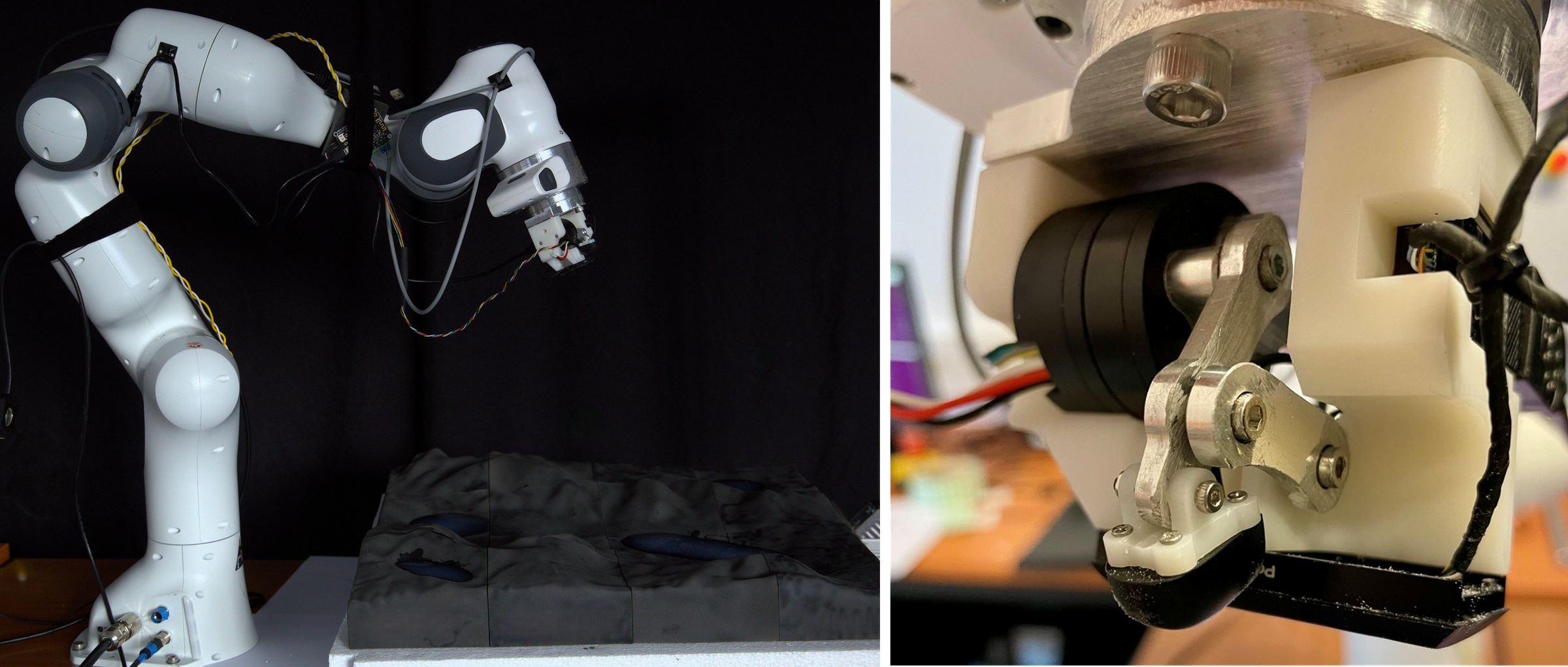 Left: the Franka Panda in the test setup. Right: the end-effector, with the compliant finger's four-bar mechanism next to the tactile array pad.
Design rationale
A single flat array captures a great deal about distributed pressure and shear over its surface, but every reading comes through one mechanical path. Adding a compliant finger brings three engineering benefits:
- A second, mechanically filtered view of the same event. The finger reaches the surface through a four-bar linkage, so its signal is shaped by a different mechanical path than the array's. In FRACTAL, each channel is a separate forward model of the same underlying interaction regime. Two channels that see one probe make a cross-modal consistency check possible.
- Safer contact. The linkage gives mechanical compliance at the point of contact, which complements the impedance control of the arm when probing unknown and possibly soft terrain.
- Concentrated, tangential probing. The fingertip gives a spatially concentrated channel for point contact and small features, and it suits the tangential (sliding) probes that FRACTAL needs to tell, for example, elastic loading apart from slip.
Specifications
Values for the end-effector as built.
| Item | Value |
|---|---|
| Manipulator | Franka Emika Panda, 7 DoF |
| Mounting | Custom assembly at the wrist flange |
| Array channel | |
| Sensor | PaXini GEN3 Omega L5321 |
| Taxels | 239, three-axis (normal + two-axis shear) |
| Sensing area | 53.38 mm × 25.10 mm |
| Role | Spatially distributed channel \mathbf{z}_t^{(\text{arr})} |
| Finger channel | |
| Fingertip sensor | PaXini GEN3 S1813 Elite |
| Taxels | 31 |
| Actuator | Permanent-magnet synchronous motor (GM2840), field-oriented control |
| Motor rated load torque | 34.3 mN·m |
| Linkage | Custom four-bar, CNC-machined from aluminum 6061 |
| Role | Spatially concentrated channel \mathbf{z}_t^{(\text{fin})} (point contact, small features) |
| Finger stiffness | Selectable through FOC |
| Linkage dimensions / travel | 4 cm |
| Fingertip force range | 0.1–8 N |
| End-effector mass | 250 g |
| Sampling rates | Selectable, 30–500 Hz |
Control architecture
The stack runs on ROS 2. The sensors are read through my ROS 2 driver for PaXini GEN3 sensors.
- Free-space motion: MoveIt 2 is used only as a planner. It produces collision-free joint-space trajectories to anchor waypoints above or next to the terrain.
- Contact: once the anchor is reached, control passes to a custom joint-space impedance controller. It regulates the mechanical impedance during contact and runs the probe state machine. MoveIt 2 plays no part near the contact site.
- Safety: commanded motions stay inside a predefined exploration region, and limits on joint efforts, positions and velocities are set before each experiment.
Probe state machine
| Phase | What happens |
|---|---|
| 1. Approach | The end-effector moves toward the surface under low stiffness. |
| 2. Contact acquisition | Contact is detected when the external-force estimate crosses a threshold. |
| 3. Interaction | The commanded probe runs: sustained press, controlled tangential slide, or brief tap. Tactile and force data stream throughout. |
| 4. Retraction | The end-effector withdraws before moving to the next anchor. |
Role in FRACTAL
FRACTAL runs an estimate-then-explore loop. It picks the next action, sends the target pose to the planning layer, collects the tactile observation when the probe finishes, and updates its beliefs about the physical field and the interaction regime. The end-effector makes each of those actions concrete:
- press, slide and tap are the action vocabulary that FRACTAL reasons over, because the same location can behave differently under each one;
- the array and the finger give the two observation channels in FRACTAL's generative observation model;
- the shared contact event makes the cross-modal consistency factor available in the formulation.
The platform was used for qualitative hardware case studies on two terrain maps made of foam and 3D-printed material. Isolating and measuring the cross-modal factor on hardware is future work. The FRACTAL paper is under review at ICRA 2027.
Not yet published
The impedance gains, the housing material and a numerical stiffness value for the finger are not published yet and will be added if they are.