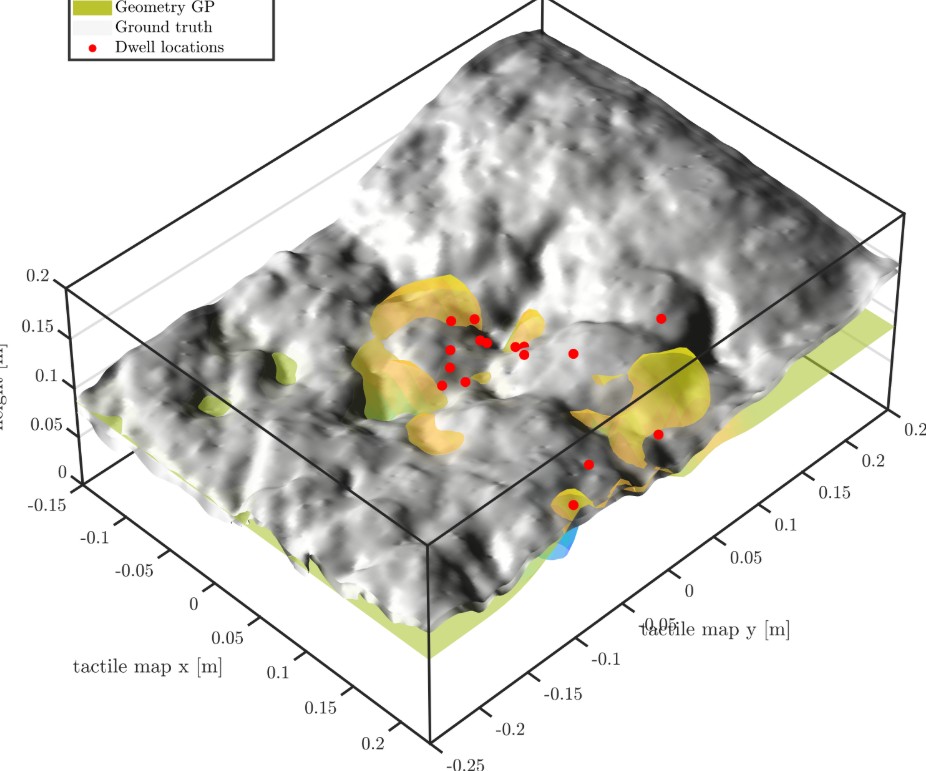
Project Overview
This is the current flagship direction of my PhD research — developing a generative, factorized model of action-conditioned tactile affordances. The goal is to teach robots to predict and understand tactile sensations before and during physical contact, enabling smarter manipulation, safer human-robot interaction, and richer understanding of objects and surfaces.
The Core Innovation
Rather than treating tactile data as a passive sensor stream, this work asks: "What tactile sensations should I expect when I perform action X on object Y?" and "What do these tactile signals tell me about what's happening?"
The key insights are:
- Factorized: Separating different aspects of tactile understanding (contact geometry, material properties, dynamics, intent)
- Action-conditioned: Predictions are informed by what the robot intends to do, not just what it observes
- Generative: Learning a model that can imagine tactile futures and compare them to reality
Technical Approach
Data-Driven Learning
The model is trained on large-scale tactile interaction datasets, collected from the humanoid hand platform with controlled robot actions (pressing, stroking, grasping, releasing, etc.) and diverse objects and materials.
Multi-Modal Representation
Factorization splits tactile understanding into independent but related sub-models:
- Contact model: Where and how deeply is the robot touching?
- Material model: What's the softness, texture, thermal properties?
- Dynamic model: How do forces and vibrations evolve over the interaction?
- Intent model: What is the robot trying to accomplish? (grasp, caress, explore, push)
Real-Time Inference
The learned models enable immediate, online prediction and interpretation of tactile signals, supporting reactive control and human-robot safety.
Applications
- Dexterous Manipulation: Robots that can handle delicate objects with confidence, adapting grip to predicted tactile feedback
- Object Exploration: Tactile-driven discovery of object properties without requiring visual input
- Haptic Feedback: Enabling robots to provide appropriate haptic responses during interaction
- Safety: Detecting anomalies or dangerous conditions through tactile prediction violations
- Human-Robot Collaboration: Robots that anticipate and respond to human touch appropriately
Current Status
Model development is underway; preliminary results show promising zero-shot generalization to novel objects and material combinations. Research is being prepared for publication.
Related Resources
- Tactile hardware: See Tactile Array for Humanoid Hand project
- Hardware platform: Meka Robotic Hand with paxini tactile sensor integration
- Blog: See "Generative Tactile Affordances" post (TODO: to be written by Adnan)