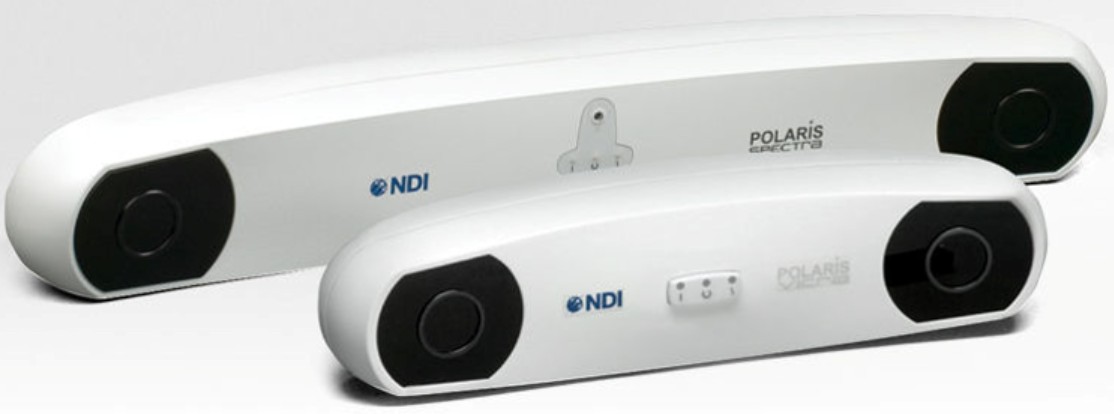
Overview
The NDI Systems ROS2 Driver is a comprehensive software stack that bridges Northern Digital Inc. (NDI) optical and electromagnetic tracking systems with the Robot Operating System 2 (ROS2). This professional-grade integration enables medical robotics applications requiring sub-millimeter precision tracking for surgical navigation, rehabilitation robotics, and biomechanical analysis.
Technical Architecture
Hardware Interface Layer
- NDI Hardware Interface: Custom C++ implementation managing direct communication with NDI Polaris and Aurora tracking systems
- Combined API Integration: Unified interface supporting both optical (Polaris) and electromagnetic (Aurora) tracking modalities
- Tool Management: Dynamic loading and initialization of tracking tools from ROM definition files
- Real-time Data Acquisition: Continuous pose estimation at configurable update rates up to 60Hz
ROS2 Control Integration
- Sensor Interface: Standards-compliant
hardware_interface::SensorInterfaceimplementation - State Broadcasting: Real-time publication of 6DOF pose data (position + quaternion orientation)
- Lifecycle Management: Complete activation/deactivation lifecycle for clinical workflow integration
- Parameter Configuration: Runtime reconfigurable tracking parameters and coordinate frames
Controller Framework
- Rigid Pose Broadcaster: Dedicated controller for publishing tracked rigid body poses
- Multi-tool Support: Simultaneous tracking of multiple surgical instruments or anatomical markers
- Transform Management: Automatic coordinate frame transformations and calibration
- Error Handling: Comprehensive error detection and recovery mechanisms
Key Features
Precision Tracking
- Sub-millimeter Accuracy: Achieves tracking precision suitable for surgical navigation applications
- 6DOF Pose Estimation: Complete position (X, Y, Z) and orientation (quaternion) data
- Tool Identification: Automatic recognition and identification of tracked instruments
- Outlier Rejection: Robust filtering algorithms for eliminating tracking artifacts
Medical-Grade Reliability
- Lifecycle Safety: Structured activation/deactivation preventing unsafe state transitions
- Connection Monitoring: Continuous monitoring of tracking system connectivity
- Data Validation: Real-time validation of tracking data quality and accuracy
- Fault Tolerance: Graceful degradation and recovery from temporary tracking loss
Clinical Integration
- URDF/Xacro Support: Complete robot description framework for surgical systems
- Launch File Templates: Pre-configured launch files for rapid deployment
- Calibration Tools: Integrated calibration procedures for clinical environments
- Documentation: Comprehensive clinical usage guidelines and safety protocols
Implementation Details
Core Components
NdiSensorHardwareInterface
class NdiSensorHardwareInterface : public hardware_interface::SensorInterface
{
    // Real-time tracking data acquisition
    hardware_interface::return_type read(const rclcpp::Time & time,
                                       const rclcpp::Duration & period) override;

    // Tool initialization and management
    void initializeAndEnableTools();
    void loadTool(const char *toolDefinitionFilePath);
};
RigidPoseBroadcaster Controller
class RigidPoseBroadcaster : public controller_interface::ControllerInterface
{
    // Real-time pose publishing
    controller_interface::return_type update(const rclcpp::Time & time,
                                           const rclcpp::Duration & period) override;
};
Data Flow Architecture
- Hardware Layer: NDI API communicates with tracking hardware
- Interface Layer: Hardware interface abstracts tracking system specifics
- Controller Layer: Specialized controllers process and publish tracking data
- Application Layer: Clinical applications consume standardized pose messages
Medical Applications
Surgical Navigation
- Instrument Tracking: Real-time position monitoring of surgical tools
- Patient Registration: Dynamic patient positioning and anatomy tracking
- Workspace Monitoring: Surgical field boundary enforcement and collision avoidance
- Procedure Documentation: Complete motion logging for post-operative analysis
Rehabilitation Robotics
- Patient Movement Analysis: Quantitative assessment of rehabilitation progress
- Robotic Assistance: Precision control of rehabilitation robots
- Biomechanical Studies: Research-grade motion capture for clinical studies
- Progress Monitoring: Longitudinal tracking of patient recovery metrics
Research Applications
- Medical Device Testing: Validation and characterization of medical devices
- Human-Robot Interaction: Study of interaction dynamics in clinical settings
- Surgical Skill Assessment: Objective evaluation of surgical proficiency
- Ergonomic Analysis: Workspace optimization for surgical environments
Technical Specifications
Supported Hardware
- NDI Polaris Systems: Optical tracking with passive marker support
- NDI Aurora Systems: Electromagnetic tracking for internal navigation
- Mixed Environments: Simultaneous optical and electromagnetic tracking
Performance Characteristics
- Update Rate: Up to 60 Hz real-time tracking
- Latency: < 50ms end-to-end system latency
- Accuracy: Sub-millimeter position accuracy, < 0.5° orientation accuracy
- Tracking Volume: Up to 1.4m³ for Polaris, unlimited for Aurora (within field generator range)
Software Requirements
- ROS2 Humble: Primary development and testing platform
- Ubuntu 22.04 LTS: Recommended operating system
- Real-time Kernel: Optional for hard real-time applications
- NDI API: Proprietary tracking system communication library
Clinical Impact
This driver enables the integration of professional medical tracking systems into research and clinical robotic applications, supporting advances in minimally invasive surgery, precision rehabilitation, and human-robot collaboration in medical environments. The system has been validated in research settings at ICube Laboratory, University of Strasbourg, contributing to multiple peer-reviewed publications in medical robotics.
Development and Collaboration
Developed in collaboration with ICube Laboratory, University of Strasbourg, this project represents a significant contribution to the medical robotics community by providing open-source access to professional-grade tracking system integration. The modular architecture supports extension to additional NDI systems and integration with custom medical robotic platforms.