The Problem: Custom Hardware Integration in ROS2
One of the biggest friction points in robotics is connecting custom hardware to ROS2. Whether you're building a gripper, an end-effector sensor, a microcontroller-based controller, or a custom input device, the current workflow is painful:
- Write C++ hardware interface driver (requires deep ROS2/control systems knowledge)
- Compile against system ROS2 libraries
- Debug integration issues
- Repeat for every new device
There has to be a better way.
The Insight: USB-HID as a Universal Standard
USB-HID (Human Interface Device) is everywhere—mice, keyboards, game controllers, custom joysticks. It's a standardized protocol built into every OS. But roboticists rarely think of it as a robotics tool.
What if we inverted the workflow? Instead of writing C++ for each device, what if you could:
- Define your device's data structure in a simple YAML configuration file
- Plug in your microcontroller (Teensy, ESP32, STM32, etc.) speaking HID
- Instantly get a ros2_control hardware interface—no compilation needed
That's hid_ros2.
The Architecture
hid_ros2 is a single, reusable hardware interface plugin for ros2_control that:
Hardware Discovery & Management
- Auto-detects connected HID devices by vendor/product ID
- Gracefully handles hot-plugging (disconnect/reconnect)
- Maintains persistent, resilient connections
Configuration-Driven Integration
- YAML file defines the device's:
- Vendor/product IDs
- Report structure (which bytes encode which sensors/actuators)
- Data types, scaling factors, offsets
- Update rate (100 Hz, 500 Hz, 1000 Hz—OS permitting)
- No code changes needed to support a new device
High-Performance I/O
- Kernel-level USB-HID access via
libhidapi(cross-platform: Linux, macOS, Windows) - Lock-free data queuing for real-time safety
- Guaranteed polling rates up to 1000 Hz on compliant hardware
- Deterministic, low-latency communication (<5ms typical, <2ms often)
ROS2-Native Integration
- Standard
ros2_controlhardware interface—works with allros2_controlcontrollers - Real-time-safe communication (memory pre-allocated)
- Seamless integration with MoveIt2, trajectory controllers, state publishers
Example: A Custom End-Effector
Imagine you build a 4-DOF custom gripper with 4 position-control motors and 6 tactile sensors. Your microcontroller (say, a Teensy 4.1) is already programmed to:
- Read 4 motor setpoints from a HID report (8 bytes, 2 per motor)
- Measure 4 encoder positions and send back a HID report (8 bytes, 2 per encoder)
- Measure 6 analog tactile sensors and send them in the same report (12 bytes, 2 per sensor)
With hid_ros2, your config looks like:
device:
  vendor_id: 0x16C0     # Teensy's default VID
  product_id: 0x0486    # Your custom PID
  report_rate_hz: 500

joints:
  motor_0:
    out_report: [0, 1]    # bytes 0-1 of outgoing HID report
    in_report: [0, 1]     # bytes 0-1 of incoming (encoder feedback)
    scale: 0.01           # encoder counts to radians
  motor_1:
    out_report: [2, 3]
    in_report: [2, 3]
    scale: 0.01
  # ... (motor_2, motor_3)

sensors:
  tactile_0:
    in_report: [8, 9]     # byte 8-9 of incoming report
    scale: 0.001          # analog to normalized pressure
  # ... (tactile_1 through tactile_5)
Then in your ros2_launch, you load the standard ros2_control gripper controller, and you're done. No custom C++ driver written.
Why This Matters
For Roboticists Without Driver Development Skills
You can integrate custom hardware without being a C++ systems programmer. This democratizes hardware integration.
For Hardware Vendors
Define once, support everywhere. A custom gripper manufacturer can ship a single YAML config file with their product, and users on any ROS2 platform can plug and play.
For Accessibility
Lower barrier to entry = more people building robots. More diverse hardware = more innovation.
For Performance
USB-HID is kernel-native on all modern OSes. You get deterministic, low-latency communication without special privileges.
For Reproducibility
Teams can share hardware configs and reproduce research results. Academic robotics labs can collaborate more easily.
The Talk at ROSCon FR 2025
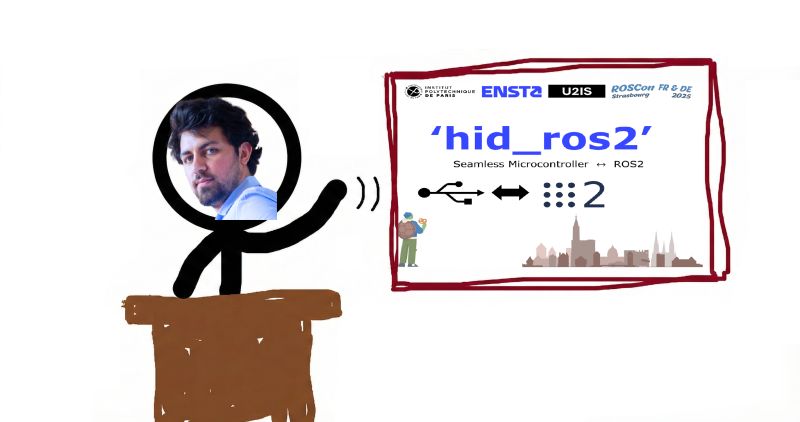
The Numbers (from ROSCon FR 2025 Talk)
Performance benchmarks on a typical Linux desktop:
- Communication latency: 1.2ms typical, <2ms 99th percentile
- CPU usage: <5% on a 4-core system
- Supported polling rate: Up to 1000 Hz (device/OS permitting; commonly 500 Hz)
- Configuration time: <1 minute for a new device (write YAML, test, done)
- Code overhead per new device: Zero lines of C++
Real-world example: We integrated 3 custom hardware platforms (microcontroller gripper, sensor array, custom input device) in a single ROSCon France workshop session—literally during the talk.
Open Source & Community
hid_ros2 is released under the Apache 2.0 license and fully open-source:
GitHub: adnan-saood/hid_ros2
Documentation: Full setup guides, example configs, troubleshooting
Community: Already in use at several robotics labs and startups; contributions welcome
What's Next?
Planned features:
- GUI tool to generate YAML configs (detect device, auto-map ports)
- Support for composite HID devices (multiple endpoints)
- Real-time safety heartbeat (watchdog timers)
- Built-in logging and telemetry for debugging
Long-term vision:
A standardized, vendor-agnostic ecosystem where hardware and software integrate as seamlessly as they do in the consumer electronics world.
Thank You ROSCon FR 2025
This work crystallized thanks to feedback from the amazing robotics community at ROSCon France. Thanks especially to:
- The ICube Strasbourg and U2IS teams for real-world testing
- The ROS2 / ros2_control maintainers for excellent framework design
- The Teensy, STM32, and ESP32 communities for supporting HID out of the box
If you have a custom hardware project and want to try hid_ros2, start here: GitHub README or grab the prebuilt ROS2 binary from apt.ros.org.
Related:
- GitHub: hid_ros2
- See the paxini_ros2 project (uses hid_ros2 under the hood)
- Blog: "Introducing hid_ros2" (launch announcement, 1 month prior)