Building on Success
Last September, we organized the first Beyond Words workshop at ICSR 2025 in Naples—an event that brought together researchers from robotics, neuroscience, psychology, and design to explore how touch shapes human-robot interaction. It was a resounding success, with standing-room-only attendance and vibrant discussions.
This July, we returned to ICSR 2026 (also in Europe) to continue the conversation with Beyond Words 2.
The 2026 Program
This year's workshop featured an incredible lineup:
Keynote Speakers:
- Prof. Shan Luo (King's College London) — "Touchable AI for Social Robotics"
- Dr. Caroline Y. Zheng (Robotics & Human-Computer Interaction)
- Raffaelle Buono (Tactile Sensing & Wearable Haptics)
- Madeleine Rischer (Psychology & Social Touch)
- Teodor-Alexandru Dicu (ENSTA U2IS, co-organizer)
Panel Discussion: "Touch and Interactive Robots: The Next Frontier in Human-Robot Interaction"
Co-Organizers:
- Prof. Patrick Henaff (ENIB, Lab-STICC)
- Adnan Saood (ENSTA U2IS) — that's me!
- Teodor-Alexandru Dicu (ENSTA U2IS)
- Prof. Adriana Tapus (ENSTA U2IS)
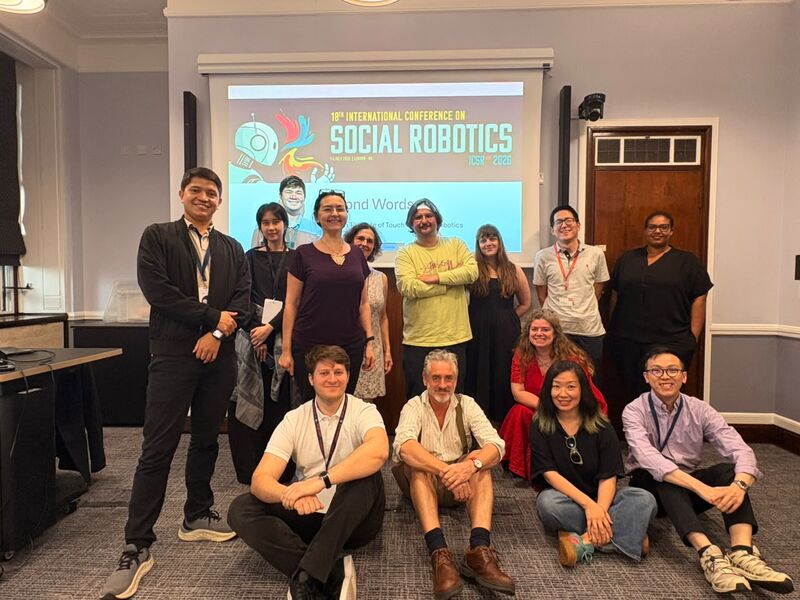
What Made Beyond Words 2 Special
1. Interdisciplinary Breadth
The beauty of touch research is that it spans neuroscience (how does the brain process tactile signals?), robotics (how do we sense and express touch?), psychology (what does touch mean to humans?), and design (how do we build systems people want to touch?). Our speakers brought all these perspectives.
2. Both Sensing & Expression
Unlike some HRI workshops that focus only on perception, we emphasized both directions:
- Tactile sensing: How robots perceive human touch (our tactile array work)
- Haptic feedback: How robots express emotion through touch (our soft haptic interface work)
3. Practical Demonstrations
Beyond talks, we had live demos:
- Artificial skin prototypes
- Soft robotic gripper systems
- Wearable haptic vests
- Real-time tactile feedback systems
Seeing and touching (literally!) the hardware makes the research tangible.
4. Community Building
The workshop isn't just about papers—it's about building a community. We had networking sessions, a panel discussion, and informal conversations over coffee. Several collaborations sprouted from this event.
Key Themes That Emerged
Safety Through Softness
A recurring theme: soft, compliant robotics are perceived as safer and more approachable. Whether it's a soft gripper, a compliant arm, or a flexible skin, softness matters. (This aligns perfectly with our handshake study findings—see related post.)
The "Uncanny Valley" of Touch
Interestingly, visual uncanny valley is well-studied, but tactile uncanny valley is not. What makes a robotic touch feel creepy versus comforting? We don't fully know yet. This is fertile research ground.
Cross-Disciplinary Translation
Neuroscientists are discovering fascinating things about human touch and stress (e.g., vagal activation through light touch), but this knowledge isn't always making it into robotics design. Workshops like Beyond Words help close that gap.
Accessibility & Assistive Robotics
A powerful session focused on how tactile feedback could help people with sensory impairments or disabilities. Robots that are gentle, responsive, and communicative through touch could be transformative for care and therapy.
Personal Reflections
Organizing Beyond Words 2 was both humbling and energizing. As someone whose entire PhD centers on touch in robotics, to see the field grow—to see more researchers, more companies, more applications—is validating.
But it also underscores how much we don't know yet. Touch is perhaps the least-studied sense in HRI. We have visual robots, auditory robots, even olfactory robots (yes, smell!), but tactile robots are still rare. This is our frontier.
What's Next?
We're already discussing Beyond Words 3. Ideas on the table:
- A hackathon component (build tactile interfaces in real time)
- Clinical applications focus (hospitals, therapy, assistive care)
- Standardization of tactile sensors and benchmarking protocols
The workshop has grown from a niche conversation to a visible part of ICSR's program. That's incredible.
Thank You
To our speakers for bringing their expertise and passion. To our participants for asking hard questions. To Teodor, Patrick, and Adriana for co-organizing and supporting the vision. And to ICSR for providing the platform.
If you're interested in touch and social robotics, mark your calendar for next year. And if you have a paper, demo, or idea to contribute, reach out—we're always looking for fresh perspectives.
Related:
- Beyond Words workshop series @ ICSR
- See the Soft Robotic Haptic Interface and Tactile Array projects
- Blog: "A Touch of Feeling in Robotics" (ENSTA feature article)