Project Overview
This undergraduate/early-career project tackles one of robotics' most compelling challenges: coordinated motion planning for large robot groups. By drawing inspiration from fluid dynamics and the mathematical elegance of the Navier-Stokes equations, we developed a novel approach to swarm robotics that treats robot formations as fluid flow patterns.
Motivation: Nature's Solutions
Observing natural swarms — flocks of birds, schools of fish, crowds of humans — reveals that elegant coordination emerges without central control. The key insight: these phenomena can be mathematically described using fluid dynamics principles.
Technical Innovation
Core Algorithm
The Navier-Stokes equations, fundamental to fluid mechanics, describe the motion of viscous fluids:
$$\frac{\partial \mathbf{v}}{\partial t} + (\mathbf{v} \cdot \nabla)\mathbf{v} = -\nabla p + \nu \nabla^2 \mathbf{v} + \mathbf{f}$$
We discretize and adapt this to robot swarms:
- Velocity field → robot velocities
- Pressure field → collision avoidance forces
- Viscosity → coordination/formation tightness
- Body forces → obstacles, goals, external inputs
Key Innovations
- Adaptive Viscosity Control: Dynamic parameter tuning for tight formations vs. rapid dispersion
- Non-holonomic Constraints: Integration of differential-drive steering limits (real robots can't move sideways)
- Multi-Scale Coordination: Simultaneous operation at micro (collision avoidance), meso (local group), and macro (global path planning) scales
Hardware Platform
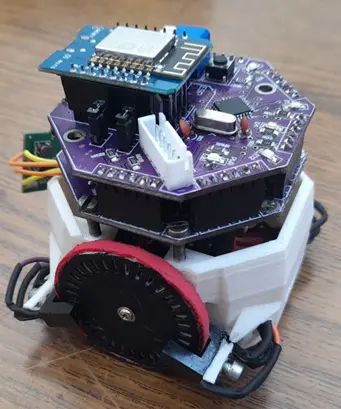
Custom-designed 15-robot swarm platform:
- Differential-drive kinematics (2-wheel steering)
- ARM Cortex-M4 microcontroller per robot
- 2.4 GHz wireless mesh networking
- 100 Hz control loop for real-time coordination
- Li-Po battery: 4-hour runtime
Experiments
Demonstrated:
- Formation-keeping through cluttered environments
- Scalable motion planning (tested up to 15 robots)
- Adaptive swarm density for obstacle negotiation
- Robustness to robot failures (graceful degradation)
Impact & Applications
- Search and rescue: Autonomous exploration of unknown terrain
- Environmental monitoring: Distributed sensor networks
- Entertainment/art: Dynamic sculptural swarm displays
- Industrial logistics: Coordinated material transport in warehouses
Related Resources
- GitHub: swarm-robot_firmware (embedded control code)
- Blog: "Swarm Robotics Inspired by Fluid Dynamics" (TODO: link to blog post once written)
Current Status
Demonstrated proof-of-concept; further development paused in favor of higher-priority PhD research. Code and hardware designs documented for future students.